

Industries · Ecommerce
Growth that keeps its margin.
 Reviewed by Adam Segall, Founder & CEOUpdated
We help online stores win Google Shopping, paid social and search, then keep buyers coming back, measured on profit per customer, not just revenue.
01Overview
What an ecommerce marketing agency should be measured on
Most stores hire an ecommerce marketing agency to grow revenue, and that is the trap. Revenue is easy to buy. Spend more on ads and sales go up. The real question is whether each new customer is worth more over time than it cost to win them. When that ratio is healthy, you can grow as fast as you like. When it is not, every sale makes the hole deeper.
So we work on two numbers at once: what it costs to acquire a customer, and what that customer is worth across every order they ever place. Lower the first with better feeds, sharper creative and a store that converts. Raise the second with email, SMS, subscriptions, bundles and a post-purchase experience people remember. Everything on our plan moves one of those two numbers.
Where stores usually leak
- A messy product feed. Missing GTINs, weak titles and wrong availability keep products out of Shopping and free listings.
- One hero channel. Nearly all spend on one ad platform, so one policy change or cost spike hits the whole business.
- A first-order mindset. No welcome flow, no post-purchase flow, no winback. Customers buy once and drift.
- Blind tracking. Browser-only pixels that miss a share of orders, so the ad platforms optimize on partial data.
- Slow product pages. Heavy themes and app bloat that cost conversions on phones.
One in-house team handles all of it. The people who fix your feed also build your Shopify store, run your ads, write your product page copy and set up your email. When the same team owns the store and the traffic, a winning ad gets a matching landing page the same week, and a slow product page gets fixed before it wastes more spend.
The question we ask in every first meeting: if you turned off all paid ads tomorrow, what share of last month's orders would still happen? The answer tells us how much of your business you own, and how much you are renting.
02Channels
Ecommerce channels compared: what each one is for
Ecommerce brands get told by every ecommerce marketing agency to be everywhere. We prefer to be excellent in a few places and add channels only when the last one is paying back. The table is the channel map we start with.
| Channel | Best at | Typical mistake | Moves which number |
|---|---|---|---|
| Google Shopping and Performance Max | Buyers searching for the exact product | A thin feed and no product exclusions | Lowers acquisition cost |
| Free product listings | Showing products on Google at no cost | Never claiming them, or feed errors | Lowers acquisition cost |
| Paid social (Meta, TikTok, Pinterest) | Creating demand for products people did not know to search for | Too few creatives, too much targeting | Lowers acquisition cost, if creative is strong |
| SEO for category and product pages | Compounding traffic you do not pay for per click | Duplicate manufacturer descriptions | Lowers blended cost over time |
| Email and SMS | Second orders, replenishment, launches | Discount every send, no flows | Raises lifetime value |
| Reviews and user content | Converting a first-time visitor | Hiding or filtering bad reviews | Lowers acquisition cost |
| Marketplaces | Reach and discovery | Giving away the customer relationship | Mixed: reach up, margin down |

Google Merchant Center is the foundation
Your product feed is the single most important asset in ecommerce search. Google's free listings help says products can appear at no cost across Search, Images, Lens, YouTube and the Shopping tab, and that ID, title, link, image link, price, description and availability are required for every product. Apparel needs color, size, age group, gender and item group ID. A clean feed feeds both your free listings and your paid Shopping ads.
If you run Shopify, the Google and YouTube channel syncs products to Merchant Center, and Shopify's product sync guide notes that products missing a description or image will not sync. We fix those errors at the source, in the product data, so they stay fixed. We also add product structured data to your pages, because Google's product structured data documentation says providing both structured data and a Merchant Center feed maximizes your eligibility.
Paid search and paid social, each with its own job
Our Google Ads team runs Shopping and Performance Max with product groups built around margin, not just category, so your best sellers with thin margins do not eat the budget. Our paid social and Facebook ads teams create demand with a steady flow of new creative. We pair the Meta Pixel with the Conversions API, which Meta's Business Help Center describes as less affected by browser errors and ad blockers than the pixel alone.
03Why Unified
Why online brands choose Unified.
Since 2006, 1,100+ businesses served, one in-house team for the store and the traffic.
Profit, not just revenue
We judge growth by what a customer costs to win against what they are worth over time. As an ecommerce marketing agency, we will cut a channel that inflates revenue but loses money, and we show you the math every month.
Store and traffic, one team
We build Shopify and custom stores with hand-coded themes, and we run the ads, SEO and email that feed them. A winning ad gets a matching page fast, and a slow product page gets fixed before it wastes spend.
Feeds done properly
Your product feed drives Shopping ads and free listings. We fix data at the source, write titles that match how people search, and add structured data, so more of your catalog is eligible and stays eligible.
Retention from day one
We build the email and SMS flows that turn first orders into second and third orders, set up sender authentication properly, and treat repeat purchase rate as a headline number.
04Retention and SEO
Retention, SEO and the store itself
Retention is where profit lives
The first order often barely pays for the ad that produced it. The second and third orders are where an ecommerce business makes money. That is why we build the core flows before we raise ad budgets: welcome, browse and cart abandonment, post-purchase, replenishment for products that run out, and winback for customers who have gone quiet.
Our email marketing services team writes and builds these flows, and we follow the rules that keep you in the inbox. Google's email sender guidelines require bulk senders to set up SPF, DKIM and DMARC, support one-click unsubscribe, and keep spam rates low. We set that up before your first campaign goes out.
SEO for products and categories
Paid traffic stops when the budget stops. Search traffic to well-built category and product pages keeps coming. Our SEO work for stores focuses on category pages that match how people shop, unique product descriptions instead of copied manufacturer text, clean internal linking, fast pages and structured data. Our guide on SEO for small business covers the basics, and our AI SEO guide explains how to get products named in AI answers, which more shoppers now use to research before they buy.
The store has to convert
Ads and SEO bring visitors. The store decides whether they buy. We design and build stores ourselves, with hand-coded themes and no page builders, through our ecommerce website design service. Product pages get clear photos, honest reviews, shipping and return details near the price, and a fast path to checkout. For campaigns and launches, our landing page design team builds pages matched to the ad that sent the visitor.
Brands we have built for
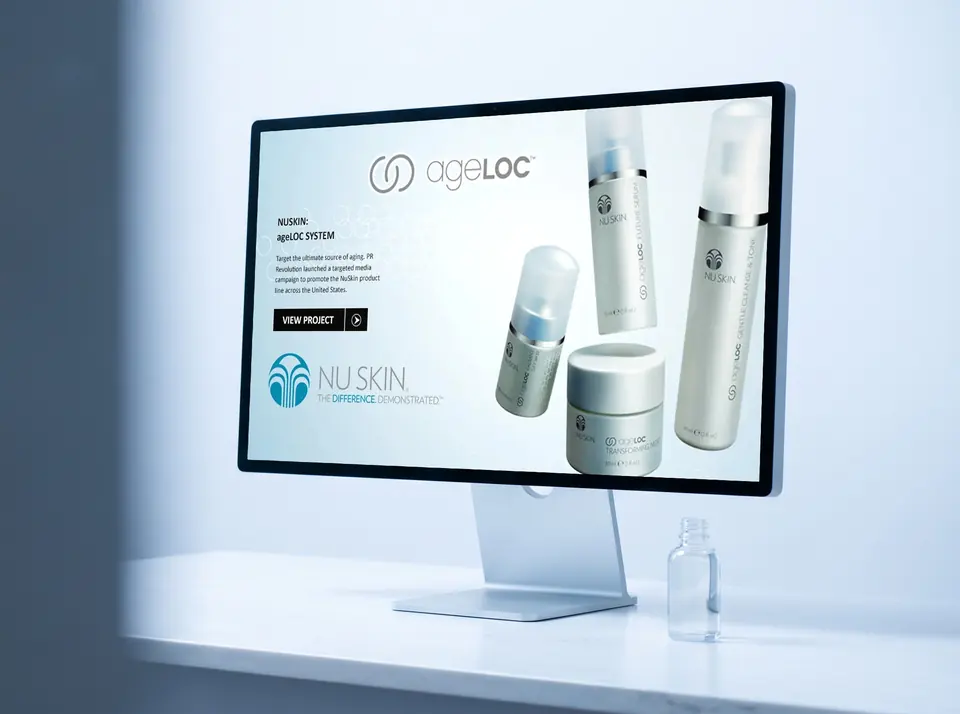
Our team has built for consumer brands including Nu Skin, the beauty and wellness company behind the ageLOC system, and Marc Anthony True Professional, the US and Canada hair care brand, where our team worked as PR Revolution on a launch that went live in January 2018. For a smaller business selling online, Joe Sale Photography got 50 SEO landing pages from us, every one scoring 99 to 100.
05First 90 days
The first 90 days with our ecommerce marketing agency
As your ecommerce marketing agency, we fix measurement and the feed first, because every other decision depends on them. Then we build retention, then we scale spend. The order matters more than any single tactic.
| Weeks | What we do | What you get |
|---|---|---|
| 1 to 2 | Audit tracking, Merchant Center, the feed, ad accounts, email flows, site speed and the checkout path. Set up server-side conversion tracking. | A clear baseline: acquisition cost, repeat rate, contribution margin by channel |
| 3 to 4 | Fix feed errors, rewrite titles for top products, add structured data, restructure Shopping and Performance Max by margin tier. | More products eligible, budget aimed at profit |
| 5 to 8 | Build welcome, abandonment, post-purchase and winback flows. Launch a creative testing cadence on paid social. Fix the slowest product pages. | Second orders start to climb |
| 9 to 12 | Scale what pays back, cut what does not, start category page SEO, report on customer value by channel. | A plan you can scale with confidence |
Reporting runs through UnifiedIQ, our own platform, which scores every page for SEO and tracks calls and forms back to their source, alongside your store and ad platform data. You get one monthly view instead of five dashboards that disagree.
What we measure
- Customer acquisition cost, blended and by channel
- Customer lifetime value and the ratio between the two
- Repeat purchase rate and time between orders
- Return on ad spend by product group and margin tier
- Feed health: approved, limited and disapproved products
- Email and SMS revenue share from flows versus campaigns
- Conversion rate and speed on product and checkout pages
06Choosing an agency
How to vet an ecommerce marketing agency
Plenty of ecommerce marketing agency pitches can show you a screenshot of a big return on ad spend. Fewer can explain what it did to your margin or your repeat rate. Use these questions with any ecommerce marketing agency you talk to.
Questions to ask
- Do you report on customer acquisition cost and lifetime value, or only on return on ad spend?
- How do you handle products with high revenue but thin margins in Shopping campaigns?
- What do you do to the product feed, and who does it?
- How many new ad creatives will you test each month, and who makes them?
- Which email flows will you build first, and how will you keep us in the inbox?
- Will the ad accounts, Merchant Center, store and email platform stay in our name?
Red flags
- Reporting platform-reported return on ad spend as if it were profit.
- Branded search counted as new customer acquisition.
- A feed that has not been touched since the store launched.
- Every email is a discount.
- Fake, bought or filtered reviews on product pages.
- Promises of a specific ranking or a specific return by a date.
If you want a straight read from an ecommerce marketing agency on where your store is leaking, send us your channel mix and a rough sense of your repeat rate. We will tell you the three changes we would make first, and what we would leave alone. Talk to our team.
07How we work
How an ecommerce engagement runs.
Measurement first, then the feed, then retention, then scale.
- Step 01
Audit and baseline
We audit tracking, Merchant Center, ad accounts, email, site speed and checkout, and set a baseline for acquisition cost, repeat rate and customer value by channel. You see where money is leaking before we touch the budget.
- Step 02
Fix the foundation
We fix feed errors, add structured data, set up server-side conversion tracking and restructure Shopping and Performance Max around margin. This is often where the quickest gains hide.
- Step 03
Build retention
We build welcome, abandonment, post-purchase, replenishment and winback flows, then start a monthly creative testing cadence on paid social.
- Step 04
Scale and report
We scale what pays back, cut what does not, add SEO for categories and products, and report monthly on customer value, not just revenue.
08What you get
What you get.
- 01
Merchant Center and feed management
Error fixes, title and attribute work, structured data and ongoing feed health checks so your catalog stays eligible for Shopping and free listings.
- 02
Shopping and Performance Max
Campaigns structured by margin tier, with product exclusions and brand separation so you can see real new-customer performance.
- 03
Paid social with creative testing
A steady pipeline of new ad creative, tested on a schedule, with server-side tracking for cleaner data.
- 04
Email and SMS flows
Welcome, abandonment, post-purchase, replenishment and winback flows, with sender authentication and one-click unsubscribe set up.
- 05
Store and landing page work
Shopify or custom store builds with hand-coded themes, faster product pages and campaign landing pages matched to your ads.
- 06
Monthly profit report
Acquisition cost, lifetime value, repeat rate and return by channel, in plain language with next month's plan.
09Results
Proof, not promises.
Verified results from live client builds: rankings, AI citations and tracked inquiries, not projections.
-
 Global Brand · US Media CampaignNu Skin
A targeted media campaign that took Nu Skin's ageLOC system to audiences across the United States.
USnationwide media campaignageLOCthe anti-aging system we promoted
Read the case study
-
 Consumer Brand · Website, Store + MediaMarc Anthony True Professional
A salon-quality hair care brand, rebuilt online as a store, a salon and a style magazine in one.
6hair collections in the launch store2markets: United States and Canada
Read the case study
-
 Photography · Custom Theme + BookingJoe Sale Photography
A portfolio you play with: the city is hidden under his name, and you wipe it away.
50SEO landing pages, every one scoring 99–10047portfolio frames, uncropped, filterable
Read the case study
10Questions
Ecommerce marketing questions, answered.
What does an ecommerce marketing agency do?
It grows online sales profitably. That usually means managing your product feed and Google Merchant Center, running Shopping, Performance Max and paid social ads, building SEO for category and product pages, writing email and SMS flows that bring customers back, and improving the store so more visitors buy. A good agency reports on acquisition cost and customer value, not just revenue.
Do you work with Shopify stores?
Yes. We build and improve Shopify stores with custom themes and no page builders, and we know the Google and YouTube channel that syncs products to Merchant Center. We also build custom stores on WordPress and custom web apps when a business needs something Shopify cannot do.
Why focus on lifetime value instead of return on ad spend?
Return on ad spend shows revenue against ad cost for one order, often as reported by the ad platform itself. It ignores margin, returns and repeat purchases. Comparing what a customer costs to win with what they are worth over time tells you whether growth is actually profitable, and how much you can afford to spend to win the next customer.
How long before we see results?
Feed and tracking fixes can improve Shopping performance within weeks, because they affect campaigns already running. Email flows start producing repeat orders as soon as they go live. SEO for category and product pages builds over several months. We report every month so you can see each layer start to contribute.
Do you make ad creative?
Yes. Our in-house team handles design, copy and video, so we can produce and test new creative every month. Creative is usually the biggest lever in paid social, and keeping it in-house means a winning idea gets new variations quickly.
Have you worked with consumer brands?
Yes. Our team has built for Nu Skin, the beauty and wellness company behind the ageLOC system, and for Marc Anthony True Professional, the US and Canada hair care brand, where our team worked as PR Revolution on a launch that went live in January 2018. Those case studies describe the work rather than share metrics.
What does it cost?
We scope each engagement after a first call around your catalog, channels and goals, and we do not publish set prices. You approve the plan and ad budgets up front, spend runs in accounts you own, and the monthly report shows what each channel produced. Call (954) 758-7200 to start.
One team. Every channel.
Websites, search, ads, content, CRM and AI software built by one in-house team, so every piece works with the others.
Grow without losing margin.
Tell us about your store and we will show you where profit is leaking. Call (954) 758-7200 or send us a note.