


Websites · Landing Pages
Pages that match the click.
 Reviewed by Adam Segall, Founder & CEOUpdated
One page per ad group, one offer per page, one obvious next step: landing pages built to turn paid and organic clicks into calls, forms and bookings.
01Overview
Landing page design that finishes what the ad started
Landing page design is the work of building a page for one kind of visitor arriving from one kind of click. Your home page has to serve everyone: buyers, job seekers, existing customers, vendors. A landing page serves one person with one question, and its only job is to get them to take one action. That focus is why sending ad traffic to a home page wastes so much budget.
Google treats the page as part of the ad. Its Quality Score help page names landing page experience as one of the three Quality Score components, defined as how relevant and useful your landing page is to people who click your ad. Our Quality Score guide explains how that feeds into what you pay and where you show.
| Page type | Audience | Goal | Navigation |
|---|---|---|---|
| Home page | Everyone | Orient and route visitors | Full menu |
| Service page | Anyone researching one service | Explain and rank in search | Full menu |
| Paid landing page | One ad group or audience | One conversion: call, form, booking or sale | Minimal or none |
| SEO landing page | One search intent, often a service and city | Rank and convert organic visitors | Light, with links to related pages |
Unified Marketing has built websites and campaigns since 2006 for more than 1,100 businesses. We design landing pages with the same team that runs Google Ads, Facebook ads and SEO, so the page and the campaign are planned together rather than handed across a wall.
02Message match
One landing page per ad group, and message match
Google's guidance on landing page experience is plain: choose a page that closely matches your ad and keywords, and mirror the ad's call to action. If the ad offers a free tour, the page should show the sign-up form for the tour. In practice that means one landing page per ad group, or at least per tightly themed group of ad groups. The searcher who typed emergency drain cleaning and the one who typed bathroom remodel quote should never see the same page.
What message match looks like

| Element | Weak match | Strong match |
|---|---|---|
| Ad promise | Plumbing services in your area | Same-day drain cleaning in Fort Lauderdale |
| Page headline | Welcome to our company | Same-day drain cleaning in Fort Lauderdale |
| Offer | Learn more about us | Book a same-day visit, or call now |
| Proof | Generic badges | Reviews and photos from drain jobs |
| Call to action | Contact us | Call now or pick a time today |
Those rows are an illustration, not a client. The principle holds for every industry: the first five seconds on the page should confirm, in the visitor's words, that they landed in the right place. Our Google Ads for small business guide shows how to group keywords tightly enough that this is possible.
Our page-per-ad-group rules
- Group by intent, not by keyword count. Emergency, price-shopping and research searches need different pages even for the same service.
- Repeat the ad's promise in the headline, using the same nouns the searcher used.
- One offer per page. A second offer is a second page.
- One primary action, with a phone call as the backup on mobile for service businesses.
- Location and audience variants come from the same template, with real local proof on each.
- Paid-only variants stay out of search with noindex when they duplicate an organic page, so they never compete with your SEO pages.
03Why Unified
Why advertisers choose Unified for landing page design.
The people who write your ads also build the pages they point to, so the promise and the page never drift apart.
Pages and ads planned together
Our landing page design work starts from your campaign structure. The team that builds your Google Ads and Meta campaigns maps every ad group to a page, so headlines, offers and calls to action match the click that brought each visitor.
Hand-coded and fast
We code pages by hand instead of renting a page builder or a separate landing page tool. Pages load fast on cellular connections, keep Core Web Vitals in the good range, and live on your own site, so you own them.
Tracked to the lead
Every call and form is tied back to its campaign and page through call tracking and UnifiedIQ. You see cost per lead and lead quality by landing page, which is what decides which pages get budget. Pages that bring cheap clicks but poor leads are spotted quickly and fixed or cut.
Tested, not guessed
We run structured experiments in order of impact: offer, message, form, proof, layout. Every test is logged, winners roll out to similar pages, and decisions rest on qualified leads, not opinions about colors. Small accounts get bigger, bolder tests so results arrive in a useful time frame.
04Page anatomy
The anatomy of a landing page design that converts
Every landing page design we build follows the same skeleton, then gets filled with the specifics of the offer. The order matters as much as the parts. Visitors decide whether to stay in seconds, so the first screen carries the promise, the proof and the action together.
First screen, on a phone
- Headline that matches the ad, with the service, the outcome and the place if location matters.
- One supporting line that answers the next question: how fast, how much effort, why you.
- Primary action: a short form, a booking button or a tap-to-call button, visible without scrolling.
- A trust signal close to the action: reviews, years in business, licenses or a recognizable result.
- A real image of the work, team or product, sized so it never pushes the action off the screen.
Below the first screen
- How it works in three or four steps, so the action feels low-risk.
- Specific proof: before and after photos where rules allow, short case results, review excerpts with permission.
- Answers to the objections your sales team hears, written as short FAQs.
- A repeat of the action after each major section.
- Contact details and policies, because Google's guidance values transparency and easy navigation.
Forms, calls and tracking
Every field you add costs completions. We ask only for what the first conversation needs, use the right mobile keyboard for each field, and send every submission to your CRM with its campaign source. Calls get the same treatment through call tracking, and UnifiedIQ ties each call and form back to its ad group, so you see cost per lead by page, not just clicks.
Speed is part of the design. Google's Core Web Vitals call a page good at Largest Contentful Paint of 2.5 seconds or less, Interaction to Next Paint of 200 milliseconds or less and Cumulative Layout Shift of 0.1 or less. Our Core Web Vitals guide covers the fixes. We also build toward WCAG 2.2 AA contrast, labels and focus states, because a form some visitors cannot complete is a leak.
Our pre-launch test for every landing page: on a mid-range phone over cellular, can you understand the offer and start the action in under ten seconds without scrolling?
05Testing
Landing page testing: what to test, in what order
A launched page is a starting point, and testing is where landing page design pays off. The fastest way to lower cost per lead is to test the page, and Google Ads has the tooling built in. Its custom experiments help page explains that an experiment shares the original campaign's traffic and budget, splits it between a control and a treatment, and for Search campaigns lets you choose a cookie-based or search-based split. A cookie-based split keeps each person on one version, which suits page tests.
| Test order | What we change | Why it comes first |
|---|---|---|
| 1. Offer | What the visitor gets for acting: quote, visit, consult, trial, guide | The offer moves results more than any design detail |
| 2. Headline and message match | Wording of the promise and how closely it mirrors the ad | Decides whether visitors stay past the first screen |
| 3. Form or action | Number of fields, form versus booking versus call | Directly changes completion |
| 4. Proof placement | Which reviews or results sit near the action | Builds trust at the decision point |
| 5. Layout and length | Short page versus long page, section order | Matters most for higher-consideration offers |
| 6. Visual details | Images, colors, button styling | Smallest effect; test last |
Testing rules we keep
- One meaningful change per test, so the result has a clear cause.
- Judge on qualified leads and sales from the CRM, not just form submissions.
- Run tests long enough to cover full weeks, since weekday and weekend traffic behave differently.
- Low-traffic accounts test bigger changes, because small tweaks need far more traffic to read.
- Keep a log of every test and result, so winning ideas spread to other pages.
Testing is the core of our website improvement and CRO program, and our conversion leak audit shows how we find what to test first on an existing page.
06Plan and hire
Planning landing page design for your campaigns
We usually build landing pages in batches tied to the campaign structure, so the first wave covers the ad groups that carry most of the spend. Our website design standards apply: prototype first, hand-coded build, no page builders.
| Phase | Typical length | What happens |
|---|---|---|
| Campaign and page map | 1 week | Ad groups, audiences and offers mapped to pages |
| Copy and design | 1 to 2 weeks | Headlines matched to ads, template designed in a mobile-first prototype |
| Build and tracking | 1 to 2 weeks | Hand-coded pages, forms to CRM, call tracking, conversion tags |
| Launch | A few days | Ads pointed to new pages, tracking verified with test leads |
| Test and expand | Ongoing | Experiments, new variants, more ad groups covered |
Questions to ask any landing page agency
- Will each ad group or audience get its own page, and how do you decide?
- How do you track calls and forms back to the campaign and keyword?
- Can we see cost per lead by landing page, not just conversion rate?
- How will you run tests, and how do you decide a winner?
- Are pages hand-coded, or built in a page builder or third-party landing page tool we would pay for separately?
- Who owns the pages and the data if we part ways?
Red flags
- Every campaign pointed at the home page or one generic page.
- Conversion rate reported with no link to lead quality or revenue.
- Fake countdown timers, invented scarcity or claims your business cannot back up.
- Pages that score well on desktop and were never tested on a phone.
- No call tracking for businesses where most leads phone in.
The results are public. Aces Airboat Tours recorded 369 booking-button clicks in its first two months, with 5 Google Ads campaigns built. Joe Sale Photography runs 50 SEO landing pages, every one scoring 99 to 100. HonestyInsure.com has 31 state pages and a 24/7 AI agent chat in the hero. For campaign management see our PPC agency page, browse the Websites practice, or send us your campaigns.
07How we work
How a landing page design engagement runs.
Map the campaigns, match the message, track the lead, test the page.
- Step 01
Map
We review your campaigns, search terms, audiences and current pages, then map each ad group or audience to a page and an offer. You approve a page plan that shows exactly where every dollar of traffic will land.
- Step 02
Write and design
We write headlines that mirror your ads, build the offer and proof for each page, and design a mobile-first template in a clickable prototype you approve before anything is coded. Each page gets proof that fits its audience, not generic badges.
- Step 03
Build and track
We hand-code the pages, connect forms to your CRM, set up call tracking and conversion tags, and submit test leads to confirm every conversion lands with its campaign source attached. Nothing goes live until the test leads show up correctly in your CRM and reports.
- Step 04
Launch and test
We point ads at the new pages, watch lead volume and quality closely, then run experiments in order of impact, rolling winners out to similar pages and adding pages as campaigns grow. You get a monthly read on cost per lead by page.
08What you get
What you get.
- 01
Campaign-to-page map
A plan matching every ad group and audience to a page, an offer and a primary action.
- 02
Message-matched copy
Headlines, offers, proof and FAQs written to mirror your ads and answer the objections your team hears.
- 03
Mobile-first prototype
A clickable template you approve before build, designed for the phone screens most visitors use.
- 04
Hand-coded pages
Fast pages on your own site with no page builder, tuned for Core Web Vitals and accessibility.
- 05
Call and form tracking
Forms into your CRM, call tracking and conversion tags, verified with test leads and reported in UnifiedIQ.
- 06
Testing program
A prioritized test plan, Google Ads experiments where they fit, a results log and winners rolled out.
09Results
Proof, not promises.
Verified results from live client builds: rankings, AI citations and tracked inquiries, not projections.
-
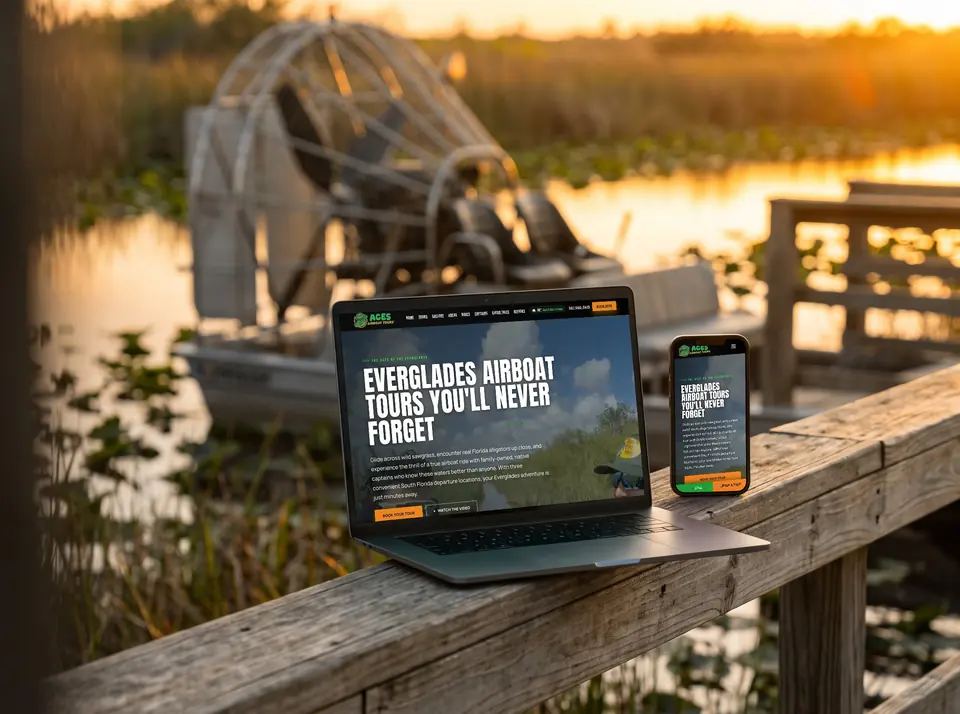 Tourism · Custom Theme + Local SEO + AdsAces Airboat Tours
A cinematic, booking-first site built to win travelers in the moment they search.
334pages live369booking-button clicks in the first 2 months
Read the case study
-
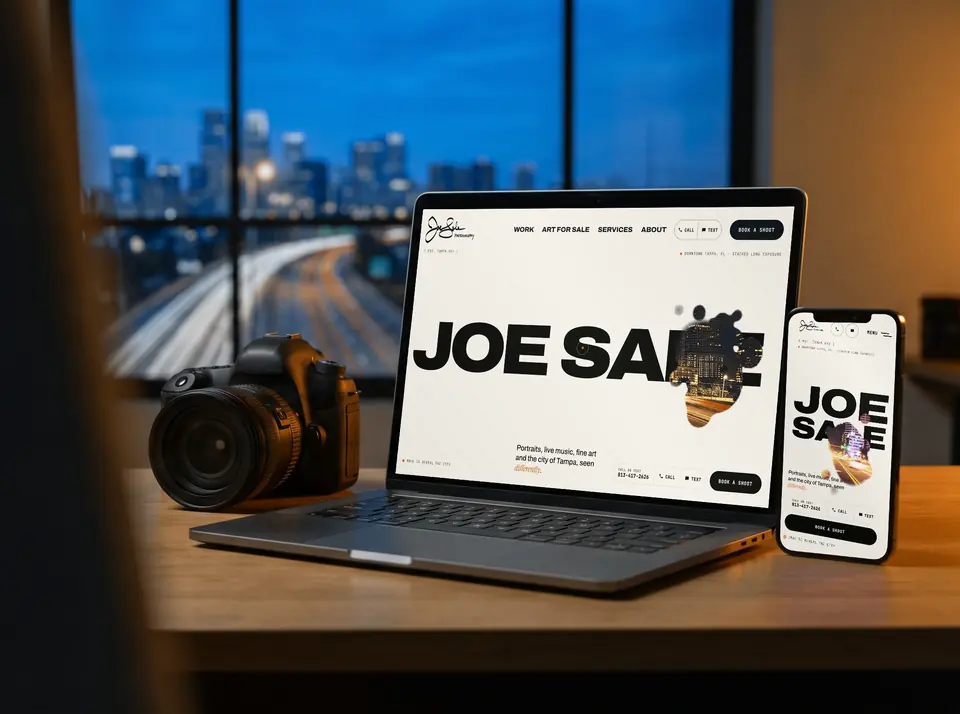 Photography · Custom Theme + BookingJoe Sale Photography
A portfolio you play with: the city is hidden under his name, and you wipe it away.
50SEO landing pages, every one scoring 99–10047portfolio frames, uncropped, filterable
Read the case study
-
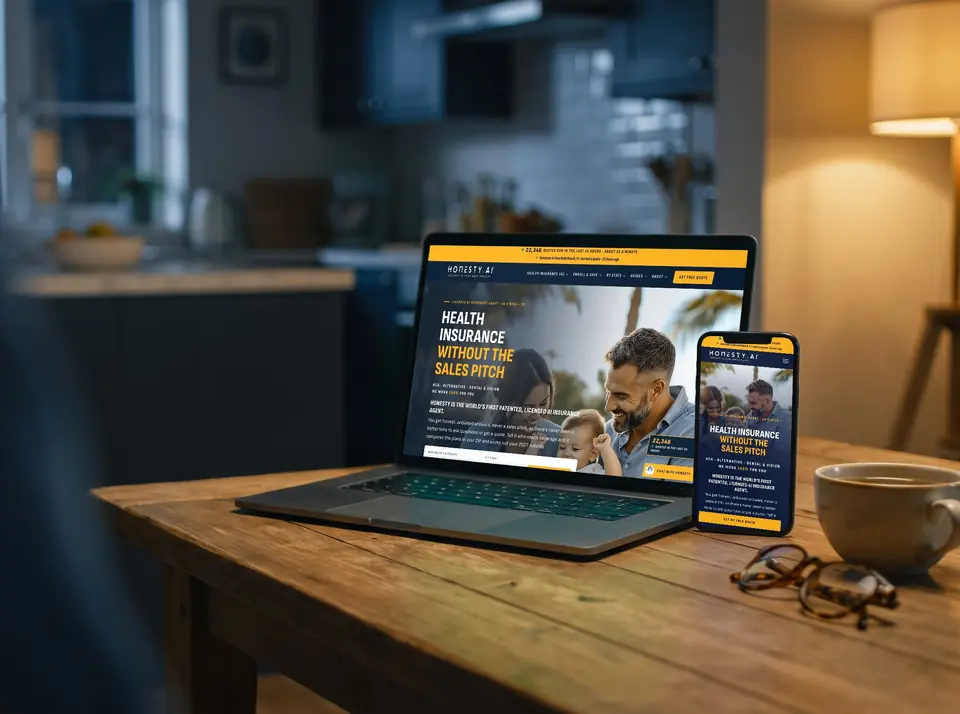 Insurance · AI Search Site + Live ChatHonestyInsure.com
A health insurance site written to be the answer AI search gives, with an AI agent that enrolls you right on the page.
144pages and guides indexed31states with their own local pages
Read the case study
10Questions
Landing page design questions, answered.
What is landing page design?
It is the design and writing of a page built for one audience arriving from one kind of click, usually an ad or a specific search, with one offer and one action. Unlike a home page, it removes distractions so the visitor either converts or leaves, which makes results easy to measure and improve.
Do I really need a separate page for each ad group?
Each distinct intent needs its own page. Google advises choosing a landing page that closely matches your ad and keywords. Ad groups with the same intent and offer can share a page, but emergency, price-shopping and research searches should land on different pages even for the same service.
Should landing pages have navigation?
Paid landing pages usually work best with minimal navigation, so visitors focus on the one action. We still include contact details, policies and a link to the main site for transparency. SEO landing pages keep light navigation and links to related pages because they also need to rank.
Do landing pages help Quality Score?
Yes. Google lists landing page experience as one of the three Quality Score components and defines it as how relevant and useful your page is to people who click your ad. Good landing page design, with a page that matches the ad, loads quickly and makes the action easy, supports a better rating.
How do you test landing pages?
We test in order of impact: offer, headline and message match, form, proof placement, layout, then visual details. For Google Ads we often use campaign experiments, which split traffic between a control and a treatment. We judge winners on qualified leads from your CRM, not just form fills.
Can landing pages also rank in Google?
Yes, when they are built for search intent with useful, original content. We build SEO landing pages for service and location searches, and keep paid-only duplicates out of the index so they do not compete with them. Joe Sale Photography runs 50 SEO landing pages scoring 99 to 100.
Do you use landing page builder tools?
No. We hand-code landing pages on your own WordPress or Shopify site. That keeps them fast, keeps the data and pages yours, and avoids paying for a separate builder subscription. Your team can still edit text and images through the fields we build.
Pairs well with.
One team. Every channel.
Websites, search, ads, content, CRM and AI software built by one in-house team, so every piece works with the others.
Make every click count.
Send us your campaigns for a landing page design review, and we will show you which ad groups need their own page. Call (954) 758-7200 or (973) 858-5988.