

Industries · Contractors
Contractor marketing that wins the bid.
 Reviewed by Adam Segall, Founder & CEOUpdated
Big projects take months to decide. We build the portfolio, search presence and follow-up that keep you in the conversation until the homeowner signs.
01Overview
What a contractor marketing agency should actually do
A contractor marketing agency is not in the business of producing leads. It is in the business of producing signed contracts for the projects you want, at a margin you can live with. For remodelers, builders and general contractors, that is a different job from emergency trades. The homeowner may research for months, collect several bids and talk to a spouse, a lender and a designer before choosing anyone.
That long runway is where most contractor marketing breaks, and where a contractor marketing agency should earn its keep. The website shows a few stock photos. A lead comes in, gets one call and a quote, then goes quiet. Six weeks later the homeowner signs with someone who simply kept in touch. We build the whole path: a portfolio that proves you do this work, search visibility for the projects you want, and follow-up that keeps you present until the decision.
Different projects, different marketing
| Project type | Typical decision time | What the buyer needs to see | Channels that win | What we measure |
|---|---|---|---|---|
| Kitchen and bath remodels | Weeks to months | Finished projects, process, timeline | SEO project pages, Search ads, Maps, reviews | Design consults booked, close rate |
| Additions and whole-home renovations | Months | Similar homes, permits handled, team | SEO, retargeting, past-client referrals | Site visits, proposals signed |
| Custom homes | Many months | Portfolio depth, budget process, references | SEO, video, referral partners | Qualified consults, contracts |
| Commercial build-outs | Months | Similar spaces, schedule discipline | SEO, direct outreach, account follow-up | Bids submitted, bids won |
| Smaller repairs and handyman work | Days | Availability, reviews, license | Maps, Local Services Ads, Search ads | Booked visits, upsell to projects |
We start by agreeing which rows you want more of. Many contractors have plenty of small calls and too few of the large projects they are best at. Marketing that treats every inquiry as equal will keep feeding the small work. Marketing aimed at the right row changes the shape of your year.
02Sales cycle
Built for the long sales cycle: pipeline stages and follow-up
Long sales cycles reward the contractor who stays organized, and the contractor marketing agency that builds the system for it. When we set up a pipeline for a contracting business, each stage has a clear definition, an owner and an automatic next step. Nothing sits in someone's head or on a sticky note in the truck. Here is the stage map we start from, adjusted to how you actually sell.
| Stage | What happens | Automatic next step |
|---|---|---|
| New inquiry | Call or form arrives with its source tracked | Text and email within minutes, call task assigned |
| Qualified | Scope, location, timing and budget range confirmed | Project-type guide sent, site visit offered |
| Site visit | Walkthrough, measurements, photos | Recap email, next steps and timeline |
| Design and estimate | Drawings, selections, pricing work | Weekly check-in so the lead never goes cold |
| Proposal sent | Written proposal delivered | Follow-up sequence over the following weeks |
| Signed | Contract and deposit | Welcome sequence, schedule and what to expect |
| In production | Work underway | Progress updates and photo requests |
| Complete | Final walkthrough | Review request, referral ask, portfolio photos |
We have built exactly this kind of system before. For HuntReserve, we built a custom CRM and booking platform with 9 drag-and-drop pipeline stages and digital waivers that replaced paper entirely. A contracting pipeline uses the same thinking: every stage visible, every handoff automatic. Our custom CRM builds and CRM guide show how we decide between configuring a tool and building one.
Speed still matters, even for big projects
A homeowner planning a kitchen still contacts several contractors in one evening. The first useful reply sets the tone. We put an instant text and email response on every inquiry, route it to the right person and remind them until it is handled. An AI assistant for contractors can catch missed calls and draft estimate follow-ups so nothing slips while you are on a job site.
The number we watch hardest: proposals sent that never got a second touch. In most contractor pipelines we audit, that list is long, and it is the cheapest revenue you will ever recover.
03Why Unified
Why contractors choose Unified.
We market the way you sell: patiently, with proof, and with a system that never drops a proposal.
Built for long decisions
We design marketing around a sales cycle measured in weeks or months. Pipeline stages, follow-up sequences and retargeting keep you in the conversation until the homeowner signs, so the projects you bid on stop disappearing into silence after the proposal goes out.
Portfolio as a search engine
Every finished project becomes a real page with photos, scope and town, built to rank and to sell. Over time your site turns into a library of proof that answers a homeowner's doubts before your first meeting and brings in the project types you want.
CRM and software in-house
We build and configure CRMs, automations and AI assistants ourselves, from simple pipelines to custom platforms like the one we built for HuntReserve. Your marketing and your sales follow-up live in one connected system instead of five tools.
Measured to the contract
Every call and form is tracked and scored in UnifiedIQ. We report proposals, signed contracts and cost per signed contract by channel, so budget follows the work that actually closes rather than the cheapest form fills.
04Portfolio
Your project portfolio is your best sales tool
For a remodeler or builder, the portfolio does the selling before you ever meet the homeowner, which is why a contractor marketing agency should treat it as the main asset. It answers the questions they are too polite to ask: have you done a project like mine, in a house like mine, near me, and did it turn out well. A gallery of unlabeled photos answers none of that. A set of real project pages answers all of it and ranks in search too.
What every project page should include
- The town and the type of home, so local buyers see themselves in it.
- The problem the homeowner had and the scope you delivered.
- Before, during and after photos from your own jobs, never stock.
- Timeline, permit handling and how you managed the work around the family.
- A short walkthrough video when the project earns it. Our video team can shoot it.
- A link to the matching service page and a clear way to start a similar project.
Built well, each project page becomes a search asset. A page about a kitchen remodel in a specific town, with real photos and a real story, can rank for searches that a generic services page never will. Over a year of projects, that adds up to a library of proof that works every day. A hand-coded site from our web design team keeps those pages fast, and our website redesign service fits contractors with a dated site and years of unused job photos.
Answer the homeowner's checklist on your site
The FTC tells homeowners how to vet contractors. Its guide to avoiding home improvement scams says to consider only licensed and insured contractors, get several written estimates and never pay the full amount up front. Your site should make each check easy: license number, insurance, a written estimate process and a payment schedule explained in plain language. Contractors who make vetting easy win the comparison.
License display is a legal issue too. Florida's section 489.119 requires the registration or certification number in every advertisement, regardless of medium. New Jersey's Attorney General has cited home improvement contractors who advertised without their registration number. We put your number wherever your state requires it.
05Channels
Which channels a contractor marketing agency should run
Contractors get pitched every channel under the sun by every contractor marketing agency that calls. Here is how we rank them for project-based work, and what each one is actually good for. The answer is rarely one channel. It is two or three run well, with tracking that shows which ones produce signed contracts.
| Channel | Best for | Weak spot | How we use it |
|---|---|---|---|
| Google Maps | Local trust, smaller jobs, reviews | Needs steady reviews and photos | Complete profile, project photos, posts |
| SEO project and service pages | Large remodels and builds | Months to mature | Pages per service, town and finished project |
| Google Search ads | High-intent remodel and build searches | Expensive clicks, tire-kickers | Tight keywords, strong negatives, tracked to contracts |
| Local Services Ads | Smaller jobs and repairs | Limited control for large projects | Test where the job mix fits |
| Paid social retargeting | Staying visible during long decisions | Weak for first contact | Project videos to recent site visitors |
| Past clients and referral partners | Highest close rates | Ignored without a system | Check-ins, referral asks, partner updates |
For Local Services Ads, Google's screening requirements for general contractors include business and owner checks, state-level licenses where local law requires them and general liability insurance for select users. That badge helps smaller jobs. For large remodels, search pages and a strong portfolio usually carry more weight.
For Maps, Google says local results depend mainly on relevance, distance and prominence, and its profile guidelines tell service-area businesses to hide their address and use their real name without keywords. We handle profiles through our local SEO and Google Business service, following the field-by-field playbook we use for every local client. Reviews feed every channel, and our review ask system runs after every finished project.
What to measure
| Metric | Why it matters |
|---|---|
| Qualified inquiries by project type | Shows whether you are attracting the right work |
| Site visits and proposals by channel | The real middle of the funnel |
| Proposal-to-signed rate | Tests follow-up and pricing |
| Cost per signed contract | The number that sets the budget |
| Average project size by channel | Some channels bring bigger jobs |
| Referral and repeat share | Your cheapest and best customers |
We track all of it with call tracking and score every inquiry in UnifiedIQ. UnifiedIQ can send signed contracts back to Google Ads as offline conversions, so the account learns to find more buyers like the ones who signed.
06Hiring
Hiring a contractor marketing agency: 90 days, questions and red flags
A contractor marketing agency should give you a dated plan that respects your sales cycle. Big-project results take longer to show in signed contracts, so the first 90 days focus on tracking, pipeline and the assets that compound.
- Days 1 to 14: tracking on every channel, pipeline stages defined, Business Profile cleanup, license display checked, review requests switched on.
- Days 15 to 45: Google Ads rebuilt around the project types you want, first project pages published, follow-up sequences live for open proposals.
- Days 46 to 75: service and town pages, more project pages, a retargeting campaign with project video, past-client outreach.
- Days 76 to 90: report on inquiries, proposals and early signed contracts by channel, budget shifted, a plan for the next two quarters.
Questions to ask any agency
- Will you report proposals and signed contracts, or just leads?
- How will you attract the project types I want more of?
- Who sets up and owns my CRM and follow-up?
- Do I own the ad accounts, profile, website, photos and tracking numbers?
- Are any of my leads shared with other contractors?
- Who is the senior person on my account?
Red flags
- Leads resold to several contractors. The FTC acted against a large lead seller over misleading lead quality claims.
- A portfolio built from stock photos.
- Monthly reports judged on clicks when your sales cycle runs for months.
- Reviews gated or bought, which Google's review policy prohibits.
As a contractor marketing agency, we will be straight with you: we do not have a contractor case study yet. Our closest proof is the pipeline we built for HuntReserve, the 3,066 pages live for Nusbaum Medical Centers and the 5 Google Ads campaigns behind Aces Airboat Tours. Start a conversation about your pipeline.
07How we work
How a contractor engagement runs.
Pipeline and tracking first, then the assets that compound.
- Step 01
Pipeline audit
We review your inquiries, open proposals, follow-up, website, portfolio and listings, then contact you as a homeowner would. You get a ranked list of where projects leak, starting with proposals that never got a second touch.
- Step 02
Set up the system
Tracking on every channel, CRM pipeline stages, automatic responses and follow-up sequences go live. From here every inquiry has a source and every proposal has a next step with an owner.
- Step 03
Build the proof
Project pages, service and town pages, a refreshed Business Profile and Google Ads aimed at the project types you want. Video and retargeting follow where the projects justify them.
- Step 04
Tune and report
Weekly budget tuning, monthly reporting on proposals and signed contracts, and a quarterly plan built around your crew capacity and the season. You talk to the senior strategist running your account.
08What you get
What you get.
- 01
Project portfolio pages
Real project pages with photos, scope, town and timeline, built to rank in search and to answer a homeowner's questions before the first meeting.
- 02
CRM pipeline and follow-up
Pipeline stages, instant responses, proposal follow-up sequences and review requests that run automatically while your team is on job sites.
- 03
Google Ads by project type
Campaigns aimed at the work you want, with tight keywords, negatives and offline conversions tied to signed contracts rather than clicks.
- 04
Maps and local SEO
A complete Business Profile, project photos, posts, service and town pages, and citation cleanup that build steady local visibility.
- 05
A hand-coded contractor site
Fast service pages, portfolio, process and payment explanation, license and insurance display, and a clear consult booking path.
- 06
Tracking and reporting
Call tracking and UnifiedIQ scoring on every channel, with monthly reporting on inquiries, proposals, signed contracts and cost per contract.
09Results
Proof, not promises.
Verified results from live client builds: rankings, AI citations and tracked inquiries, not projections.
-
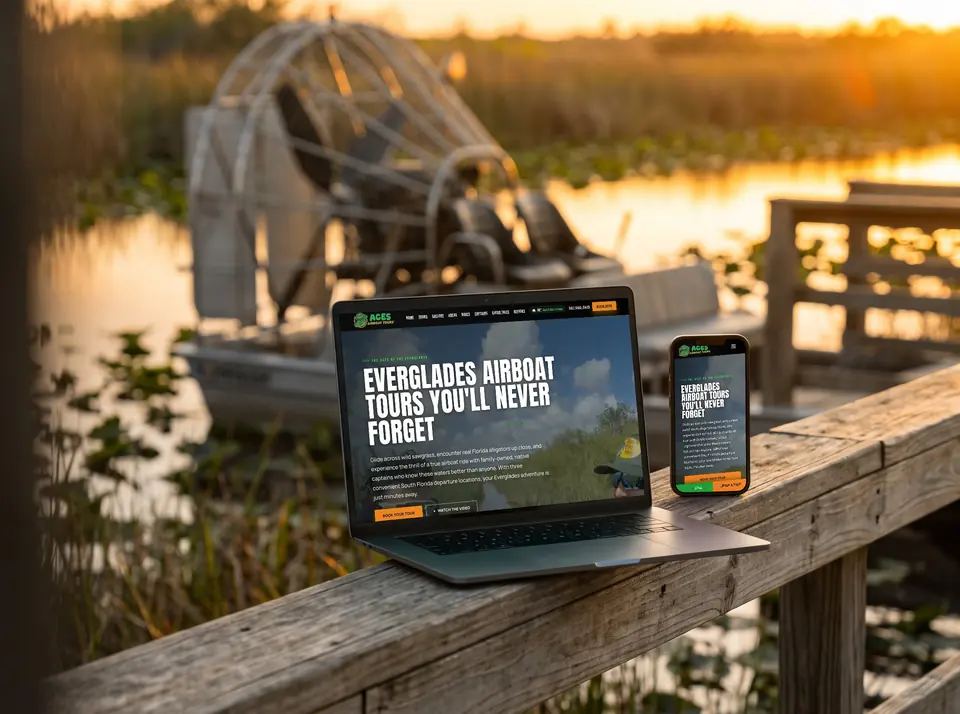 Tourism · Custom Theme + Local SEO + AdsAces Airboat Tours
A cinematic, booking-first site built to win travelers in the moment they search.
334pages live369booking-button clicks in the first 2 months
Read the case study
-
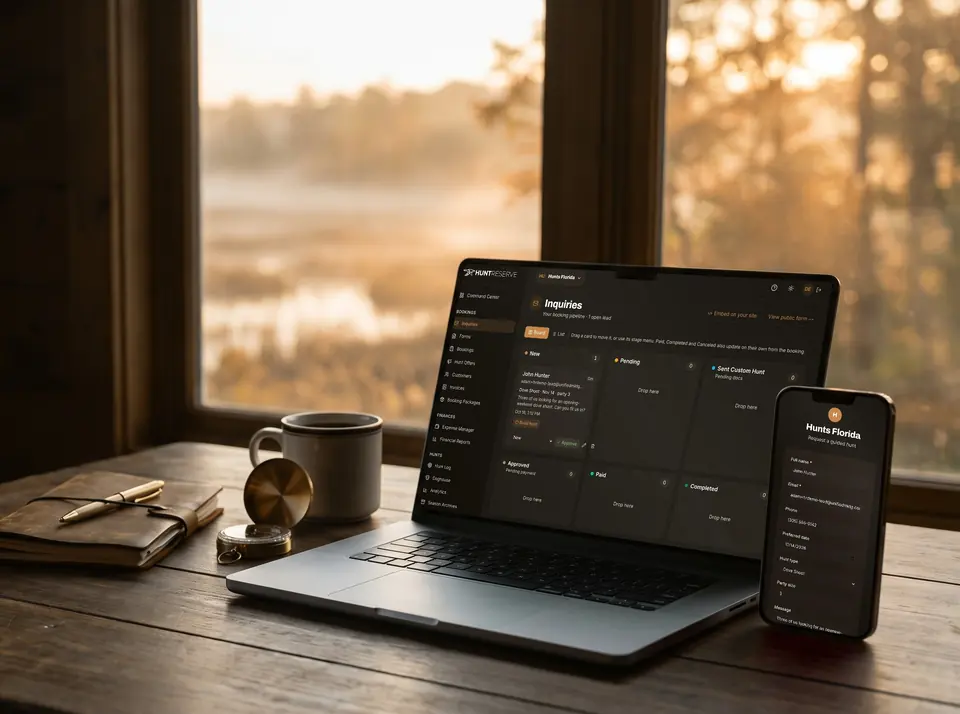 SaaS · Booking & Operations PlatformHuntReserve
From a stranger's inquiry to a paid, waivered, licensed hunting party without a single phone call.
9pipeline stages, drag-and-drop1personal link per hunter: details, license, waiver
Read the case study
-
 Medical · Custom Theme + SEO + AdsNusbaum Medical Centers
A 3,000-page medical authority that Google ranks first and ChatGPT recommends by name.
3,066pages live1,285search terms ranking on Google
Read the case study
10Questions
Contractor marketing questions, answered.
What does a contractor marketing agency do?
It brings in qualified project inquiries and helps you turn them into signed contracts. That covers the website and project portfolio, Google Maps, Google Ads, reviews, CRM pipeline setup and follow-up for open proposals. A good one reports proposals and signed contracts, not just leads, because contracting sales cycles are long.
How long before marketing produces signed projects?
Inquiries from Google Ads can start within weeks once tracking and landing pages are live. Signed contracts follow your normal sales cycle, which can run weeks or months for large remodels. Maps and SEO build over several months. We report early indicators like site visits and proposals so you can judge progress before contracts close.
Do project photos really help with SEO?
Yes, when they live on real project pages with the town, scope and story, not in an unlabeled gallery. Those pages can rank for specific searches and give homeowners proof that you have done a project like theirs. Use your own photos, never stock, and add short videos for the best projects.
Should contractors use Local Services Ads?
They can help with smaller jobs and repairs. Google screens general contractors with business and owner checks, licenses where local law requires them and insurance for select users. For large remodels and custom builds, a strong portfolio, search pages and follow-up usually matter more than the badge.
Do we have to show our license number in ads?
It depends on your state. Florida requires the registration or certification number in every advertisement, and New Jersey has cited home improvement contractors who advertised without their registration number. We check your state's rule and put the number wherever it needs to appear.
Will we own the website and accounts?
Yes. Your domain, website, project photos, ad accounts, Business Profile, CRM data and tracking numbers stay in your name. We work inside them with your permission, and everything stays with you if you ever leave. We also keep a written list of every account, login and access level, so you always know who can touch what and nothing depends on one person at our agency.
Do you have contractor case studies?
Not yet, and we will not invent one. Our closest published proof is the custom CRM with 9 pipeline stages we built for HuntReserve and the large page builds and tracking for clients like Nusbaum Medical Centers. We are happy to show how those systems map to your business.
Pairs well with.
- Website designPortfolio sites that sell the project
- Local SEO and Google BusinessSteady local visibility and reviews
- Google AdsCampaigns tied to signed contracts
- Custom CRM buildPipelines that never drop a proposal
- AI for contractorsCatch missed calls and follow up on estimates
- HuntReserve case studyCustom CRM with 9 pipeline stages
One team. Every channel.
Websites, search, ads, content, CRM and AI software built by one in-house team, so every piece works with the others.
Keep every bid alive.
Tell us the projects you want more of and how you follow up today, and we will show you where signed work is slipping away. Call (954) 758-7200 or book a strategy call.