

Industries · HVAC
HVAC marketing that books the call.
 Reviewed by Adam Segall, Founder & CEOUpdated
Heating and cooling demand follows the thermometer. We build the Maps, ads, site and call handling that catch every surge and fill the slow months with maintenance work.
01Overview
What an HVAC marketing agency should actually own
A good HVAC marketing agency is judged on one number: booked jobs that make money. Clicks, impressions and ranking reports are inputs. The output is a dispatch board that stays full in July, January and the dead weeks in between. That means owning the whole chain, from the Google Maps listing a homeowner sees at 9 p.m. to the moment a CSR books the visit.
Most heating and cooling companies that call an HVAC marketing agency have the pieces but not the chain. There is a website from a template vendor, a Google Ads account someone set up years ago, a Business Profile with old photos, and a phone line that rolls to voicemail after five. Every piece leaks. Our job is to connect them so a surge in demand turns into revenue instead of missed calls.
Three kinds of HVAC jobs, three different marketing plays
Repair, replacement and maintenance come from different searches, have different urgency and deserve different budgets. Treating them as one bucket called leads is the most expensive mistake in the trade. Here is how we split them on day one.
| Job type | How the homeowner searches | Urgency | Channels that win | What we measure |
|---|---|---|---|---|
| Emergency repair (no cool, no heat) | ac repair near me, furnace not working, open now | Hours | Local Services Ads, Maps, call-only Search ads | Answered calls, booked same-day visits |
| System replacement | new ac unit cost, heat pump installation, best furnace brand | Weeks | Search ads, SEO pages, reviews, financing pages | In-home estimates set, close rate |
| Maintenance and tune-ups | ac tune up, furnace inspection, hvac maintenance plan | Planned | Email, SMS, Maps posts, retargeting | Plan sign-ups, renewals, tune-up bookings |
| Indoor air quality and add-ons | whole home dehumidifier, air purifier install | Low | SEO content, site upsell blocks | Add-on revenue per ticket |
The split matters because the economics differ. An emergency call is worth answering at almost any hour, and it often opens the door to a replacement conversation. A replacement lead needs patience, proof and a follow-up system. A maintenance plan member is the cheapest customer you will ever acquire twice. We build each path on its own, then report them side by side so you can see which one is carrying the business.
Rule we use: never let replacement leads and repair calls share one budget line. When they do, the account chases the cheap repair clicks and starves the high-value installs.
02Channels
Local Services Ads vs Search vs Maps for HVAC
Three Google surfaces decide most HVAC calls: Local Services Ads at the very top, regular Search ads under them, and the Maps pack. Each has a different cost model and a different job. Our Local Services Ads guide covers setup in detail. Here is the comparison we walk owners through before an HVAC marketing agency spends anything.
| Channel | You pay for | Best for | Watch out for | Our default |
|---|---|---|---|---|
| Local Services Ads | Each valid lead (call, message, booking) | Emergency repair, fast trust signal | Lead disputes, thin control over keywords | Run it, answer every lead, ask for reviews |
| Google Search ads | Each click | Replacement, financing, specific brands | Broad match waste, junk calls | Tight phrase and exact sets, call tracking on |
| Google Maps (organic) | Nothing per click | Steady repair and service calls | Slow to build, proximity limits | Full profile, photos, reviews, local pages |
| Organic SEO pages | Nothing per click | Replacement research, service-area towns | Months to mature | One page per service and town that has demand |
What Google actually checks in Local Services Ads
Google lists HVAC as an urgent category. Its screening and verification requirements include business and owner checks, state-level licenses where local law requires them, general liability insurance for select users, and an extra layer of background checks on the service professionals who go into homes. Plan for that paperwork early. Verification delays are the most common reason an HVAC account sits idle in its first month.
Ranking inside Local Services Ads is not a mystery either. Google's own ranking explanation names your bid, how likely you are to get a lead, your responsiveness, your rating and review count, and the verification checks you have completed. Responsiveness is the lever most shops ignore. A company that answers in seconds and replies to messages fast will often outrank a bigger competitor with a lazy phone line.
On billing, Google charges for valid leads, and a missed call during business hours can count if the caller stays on the line more than 20 seconds. That one rule is why we push HVAC clients to staff the phones or add an answering layer before they raise the budget.
Maps is the long game that pays every season
Google says local results are based mainly on relevance, distance and prominence. For an HVAC company, that means a complete profile, the right primary category, real job photos, steady reviews, and service-area pages on your site that match the towns you actually cover. Our field-by-field profile playbook and our local SEO and Google Business service handle this work. Most HVAC companies are service-area businesses, and Google's profile guidelines say to hide your address in that case and keep keywords out of your business name.
03Why Unified
Why HVAC companies choose Unified.
One in-house team since 2006, senior people on every account, and a platform that ties every call to a booked job.
Booked jobs, not lead counts
We report cost per booked job by channel and job type, because that is the number that pays your techs. Every call and form is tracked in UnifiedIQ, so the monthly review starts with revenue and ends with the next move, not a pile of impressions.
A plan for the weather
Your budget, ad copy and offers shift with the season and the forecast. Spring and fall push tune-ups and plan renewals, peaks push emergency service with capacity caps, so you are never paying for calls your team cannot run.
Everything under one roof
Local Services Ads, Google Ads, Maps, a hand-coded site, call tracking, CRM follow-up and reviews come from one senior team. Nothing gets lost between a web vendor, an ads freelancer and a phone service that never talk to each other.
You own every asset
Your ad accounts, Business Profile, website, domain and tracking numbers stay in your name. If you ever leave, the history, the reviews and the data leave with you. That is how an agency earns the next year instead of trapping you in it.
04Seasons
Marketing to the thermometer: an HVAC season plan
HVAC demand is weather with a phone number attached. The first heat wave of summer and the first hard freeze of winter flood every shop in town at once. The shoulder months go quiet. An HVAC marketing agency that runs the same budget and the same ads all year is wasting money in April and losing calls in July. We plan the year in four blocks and adjust weekly against the forecast.
| Season | What homeowners need | What we push | Budget posture |
|---|---|---|---|
| Spring | Cooling check before summer | AC tune-up offers, maintenance plan sign-ups, replacement content | Build, moderate spend |
| Summer peak | No-cool repairs, failed systems | Local Services Ads, call-only ads, after-hours coverage | Full spend, capacity caps |
| Fall | Heating check before winter | Furnace and heat pump tune-ups, plan renewals | Build, moderate spend |
| Winter peak | No-heat repairs, emergency replacements | Emergency ads, Maps posts, financing pages | Full spend, capacity caps |
The spring and fall blocks are not filler. ENERGY STAR's maintenance checklist tells homeowners to check the cooling system in spring and the heating system in fall, because contractors get busy once peak season arrives. That is a federal program handing you a reason to call your customer list twice a year. We build those campaigns around tune-ups and plan renewals so your techs stay busy before the rush.
Why maintenance plans are your best marketing channel
A maintenance agreement does three jobs at once. It fills slow weeks with scheduled work, it puts a tech in front of aging equipment before it fails, and it gives you permission to market to that household every season. We treat plan members as their own audience: reminder sequences by email and text, a simple renewal page, and a review ask after every visit. Our review ask system fits right into that visit.
Capacity is the other half of seasonal planning, and the part an HVAC marketing agency most often ignores. When the board is full on a 98-degree day, more ad spend only creates angry callers. We set budget caps tied to your tech count and switch ads toward replacement and next-day bookings when same-day slots are gone. The goal is a full schedule at the best margin, not the most calls.
Weather trigger we set up: when the 7-day forecast crosses your local peak thresholds, budgets and ad copy shift toward emergency service, and your team gets a heads-up to staff the phones.
05Speed to lead
Speed to lead, call tracking and the numbers that matter
Homeowners with a dead AC usually call more than one company. The first one to answer and offer a time often gets the job. That makes speed to lead an HVAC marketing agency problem, not just an operations problem. If your ads ring a phone nobody picks up, the marketing failed no matter what the click report says.
- Answer live, around the clock in peak season. Use an in-house CSR, an answering service, or an AI receptionist that books and hands off cleanly.
- Call back missed calls within minutes. Automatic text-back buys you time and keeps the homeowner from dialing the next listing.
- Reply to Local Services Ads messages fast. Google weighs responsiveness in ranking, so slow replies cost you twice.
- Follow up on every replacement estimate. A sequence that runs for weeks, not one call the day after.
Track every call back to its source
We put dynamic call tracking on the site, the ads and the Business Profile, then score every call and form in UnifiedIQ. You see which campaign, keyword and page produced each booked job. UnifiedIQ can send booked jobs back to Google Ads as offline conversions, so bidding learns to chase installs instead of tire-kickers. That is how we ran the Aces Airboat Tours build: 5 Google Ads campaigns and 369 booking-button clicks tracked in the first 2 months.
| Metric | Why it matters | Healthy direction |
|---|---|---|
| Answered call rate | Missed calls are paid leads lost | Up, close to every call in hours |
| Booked jobs by channel | Shows what is carrying revenue | Rising in the channels you fund |
| Cost per booked job | The only cost number that pays bills | Down or stable as volume grows |
| Estimate-to-close rate | Tests replacement follow-up | Up after follow-up sequences start |
| Maintenance plan members | Recurring, low-cost demand | Growing every season |
| Review count and rating | Feeds Maps and Local Services Ads | Steady new reviews monthly |
Your website ties it together, and it is the asset an HVAC marketing agency should never rent to you. A hand-coded site from our web design team loads fast on a phone in a hot attic, puts the phone number and booking button on every screen, and gives each service and town its own page. For campaigns we build dedicated landing pages so ad traffic never lands on a generic homepage.
06Hiring
Your first 90 days with an HVAC marketing agency
A real plan from an HVAC marketing agency has dates, owners and a definition of done. Here is the 90-day sequence we run for heating and cooling companies. It front-loads tracking so every dollar after week two is measured, and it gets Local Services Ads live while the slower Maps and SEO work builds underneath.
- Days 1 to 14: measure and fix the leaks. Call tracking, conversion tracking, Business Profile cleanup, Local Services Ads verification started, phone coverage plan agreed.
- Days 15 to 45: turn on demand. Local Services Ads live, Google Ads rebuilt with separate repair and replacement campaigns, negative keywords, first landing pages, review requests switched on.
- Days 46 to 75: build the base. Service and town pages, maintenance plan page, seasonal campaign for the next shoulder month, follow-up sequences for estimates.
- Days 76 to 90: tune and report. Cost per booked job by channel, budget moved toward winners, a written plan for the next peak season.
Questions to ask any HVAC marketing agency
- Will you report booked jobs and cost per booked job, or just leads and clicks?
- Do I own the Google Ads account, the Business Profile, the website and the call tracking numbers?
- How will you separate repair, replacement and maintenance budgets?
- What do you change when the forecast spikes or the board is full?
- Who runs my account day to day, and how senior are they?
- Do you sell the same leads to my competitors?
Red flags we see in the trade
- Shared or resold leads presented as exclusive. The FTC acted against a major lead seller over misleading claims about lead quality.
- Ranking promises or a contract that leaves the ad account in the agency's name.
- Fake or gated reviews. Google's review policy bans selectively asking only happy customers.
- Reports with impressions and clicks but no calls, bookings or revenue.
- One budget for the whole year with no weather plan.
We do not have an HVAC case study to show you yet, and we will not pretend otherwise. The proof is the system: the local search work that took the Center for Spiritual Living to #1 on Google and Maps in Fort Lauderdale, and the tracking that logged 1,645 inquiries for Nusbaum Medical Centers in 12 months. Read our HVAC marketing playbook, then book a strategy call.
07How we work
How an HVAC engagement runs.
Tracking first, demand second, then the long-term base under it.
- Step 01
Audit the call path
We call your business as a homeowner would, review your ads, Maps listing, site and phone coverage, and map every place a booked job leaks out. You get a plain list of fixes ranked by how much revenue each one is losing.
- Step 02
Install tracking
Call tracking, form tracking and conversion tracking go live across the site, ads and Business Profile. From this point every booked job has a source, and every campaign decision is made on real numbers instead of guesses.
- Step 03
Launch and rebuild
Local Services Ads verification, separate repair and replacement campaigns, negative keyword lists, landing pages and a cleaned-up profile. Demand starts flowing within weeks while we build service and town pages underneath.
- Step 04
Tune every week
We review calls, cost per booked job and capacity weekly, shift budget toward what books, and plan the next seasonal push before it arrives. Monthly, you get a short report and a call with the strategist running your account.
08What you get
What you get.
- 01
Local Services Ads setup
Verification paperwork, service categories, service area, budget and lead handling, plus a review routine that lifts your profile quality where Google ranks it.
- 02
Google Ads rebuilt
Separate repair, replacement and maintenance campaigns with tight keywords, negative lists, call extensions and offline conversion tracking tied to booked jobs.
- 03
Maps and local SEO
A complete Business Profile, real job photos, posts, service-area pages and citation cleanup that build Maps visibility you do not pay for per click.
- 04
A hand-coded HVAC site
Fast pages for every service and town you cover, a maintenance plan page, financing information and a booking path on every screen.
- 05
Call tracking and UnifiedIQ
Every call and form tied to its source and scored, with booked jobs sent back to Google Ads so bidding learns what a good customer looks like.
- 06
Season and follow-up plan
Tune-up campaigns, plan renewal reminders, estimate follow-up sequences and a weather-based budget plan your team can see in advance.
09Results
Proof, not promises.
Verified results from live client builds: rankings, AI citations and tracked inquiries, not projections.
-
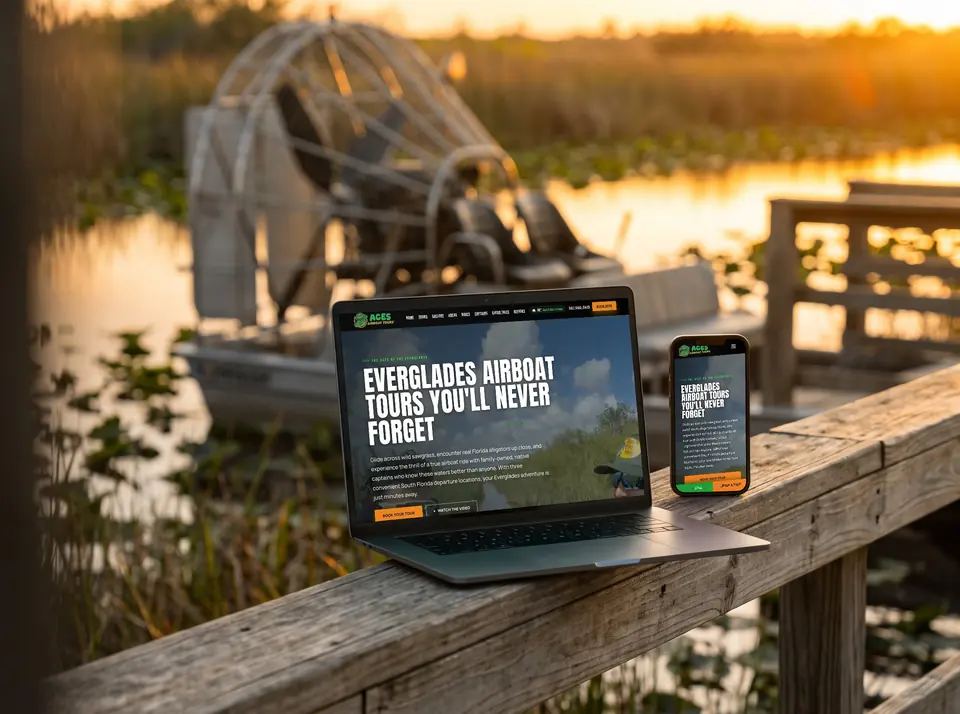 Tourism · Custom Theme + Local SEO + AdsAces Airboat Tours
A cinematic, booking-first site built to win travelers in the moment they search.
334pages live369booking-button clicks in the first 2 months
Read the case study
-
 Medical · Custom Theme + SEO + AdsNusbaum Medical Centers
A 3,000-page medical authority that Google ranks first and ChatGPT recommends by name.
3,066pages live1,285search terms ranking on Google
Read the case study
-
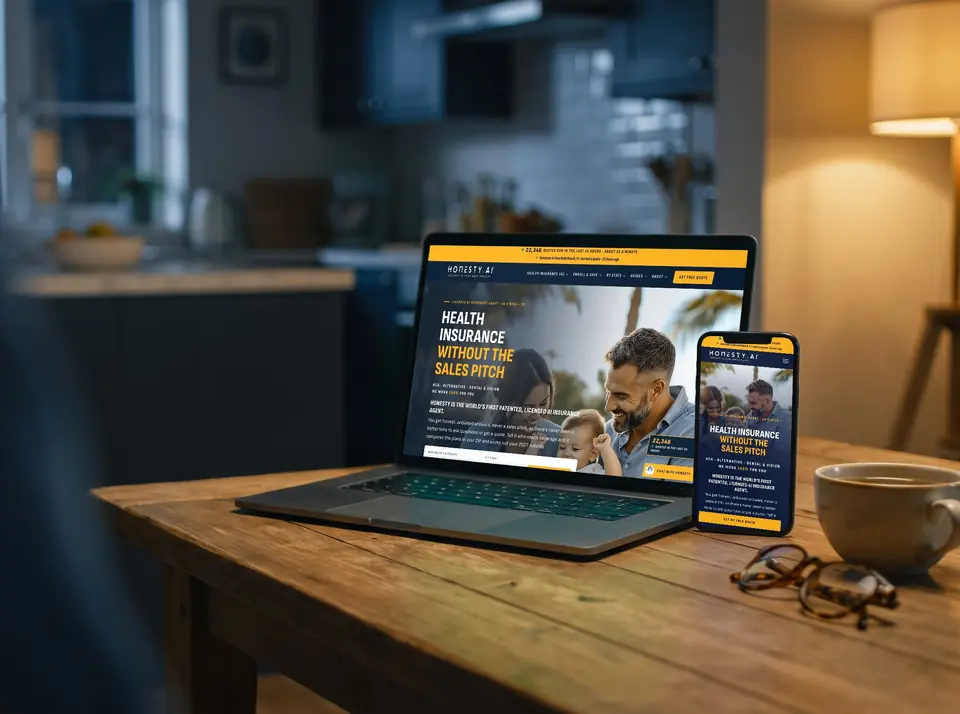 Insurance · AI Search Site + Live ChatHonestyInsure.com
A health insurance site written to be the answer AI search gives, with an AI agent that enrolls you right on the page.
144pages and guides indexed31states with their own local pages
Read the case study
10Questions
HVAC marketing questions, answered.
What does an HVAC marketing agency do?
An HVAC marketing agency brings in booked heating and cooling jobs. That covers Local Services Ads, Google Ads, Google Maps, the website, call tracking, review requests and follow-up for replacement estimates. A good one reports cost per booked job by channel, plans around the seasons, and makes sure the phone gets answered when the ads are running.
Are Local Services Ads worth it for HVAC?
For most HVAC companies, yes, especially for emergency repair. You pay per valid lead rather than per click, and the listing sits at the top of the results. The catch is verification paperwork and responsiveness. Google weighs how fast you answer, so a shop that misses calls pays for leads it never books.
How long until we see more calls?
Local Services Ads and Google Ads can produce calls within weeks of launch once verification clears. Maps and organic SEO take longer, usually several months, because reviews, photos and pages build up over time. We run both from the start so paid demand covers the gap while the free channels grow.
Should we market differently in summer and winter?
Yes. Peak seasons call for emergency messaging, full budgets and capacity caps tied to your tech count. Spring and fall are for tune-ups, maintenance plan sign-ups and replacement content. ENERGY STAR itself tells homeowners to schedule cooling checks in spring and heating checks in fall.
Do you work with HVAC companies outside Florida and New Jersey?
Yes. Our offices are in South Florida and New Jersey, and we serve businesses across the United States. Local search work is done for your actual service area, with pages and profiles built around the towns you cover and the way people there search.
Will we own our ad accounts and website?
Yes. Your Google Ads account, Local Services Ads account, Business Profile, domain, website and tracking numbers stay in your name. We work inside them with your permission. If you ever leave, everything stays with you. We also keep a written list of every account, login and access level, so you always know who can touch what and nothing depends on one person at our agency.
Do you have HVAC case studies?
Not yet, and we will not invent one. Our published proof comes from other local and service businesses, like the local search work that put the Center for Spiritual Living #1 on Google and Maps in Fort Lauderdale, and the call and form tracking behind 1,645 tracked inquiries for Nusbaum Medical Centers.
Pairs well with.
- Local SEO and Google BusinessWin the Maps pack in your service area
- Google AdsRepair and replacement campaigns that book
- Call trackingEvery call tied to its source
- HVAC marketing playbookThe 2026 guide for more booked calls
- Google Local Services Ads guideSetup, ranking and lead quality
- Aces Airboat Tours case study5 campaigns, 369 booking clicks in 2 months
One team. Every channel.
Websites, search, ads, content, CRM and AI software built by one in-house team, so every piece works with the others.
Fill the board every season.
Tell us your service area and your slowest months, and we will show you where the calls are leaking. Call (954) 758-7200 or book a strategy call.